TSX.V: SKP
OTC: STKXF
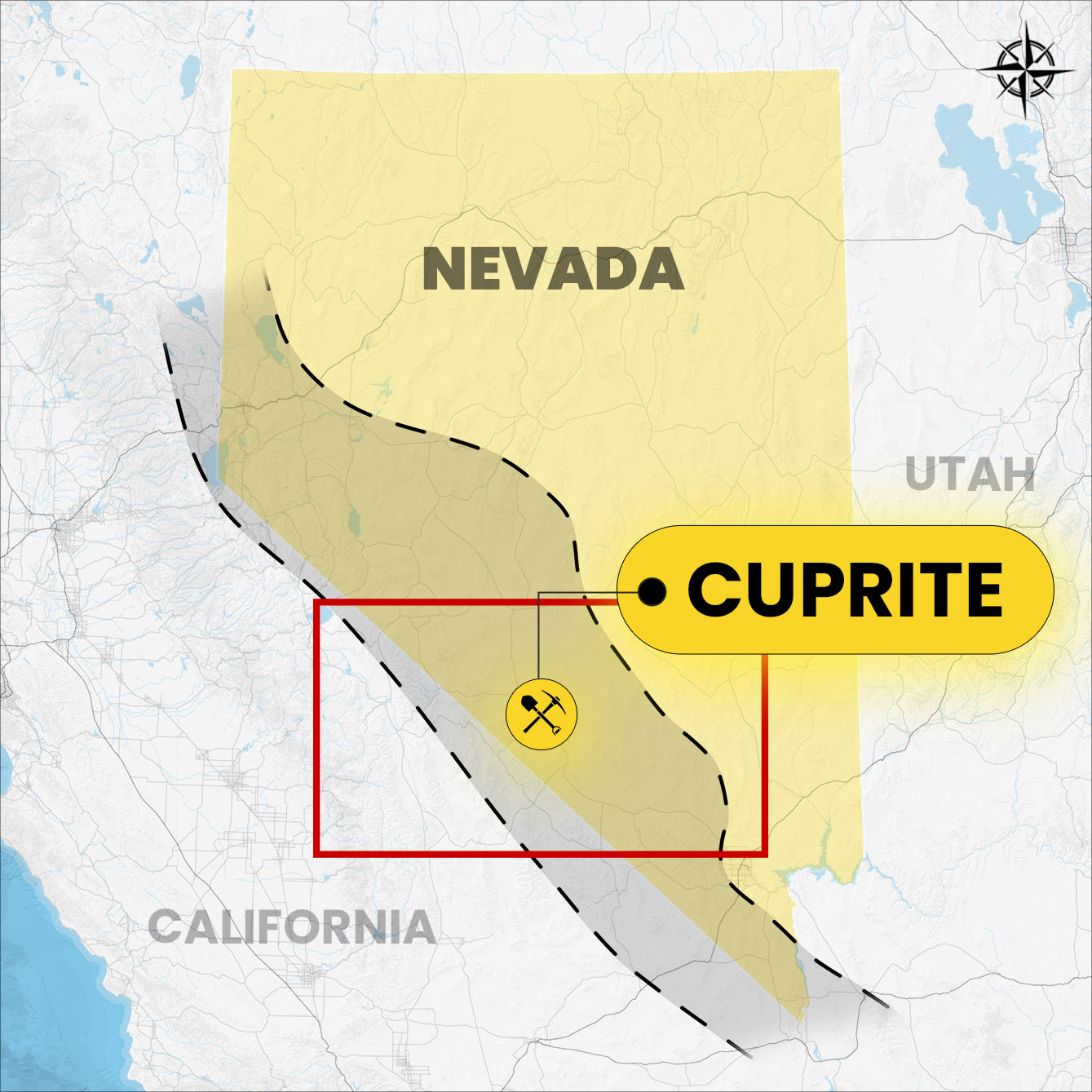
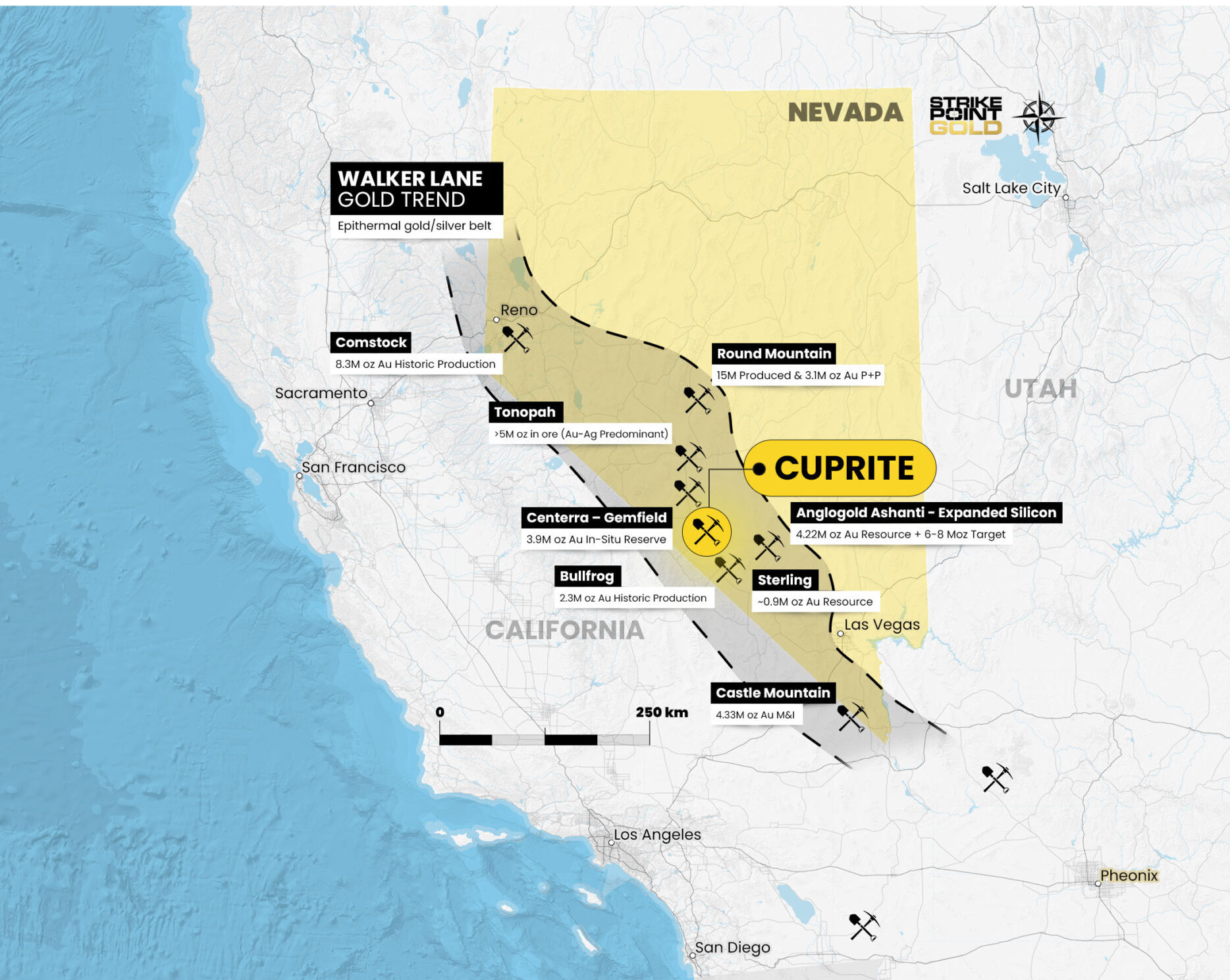
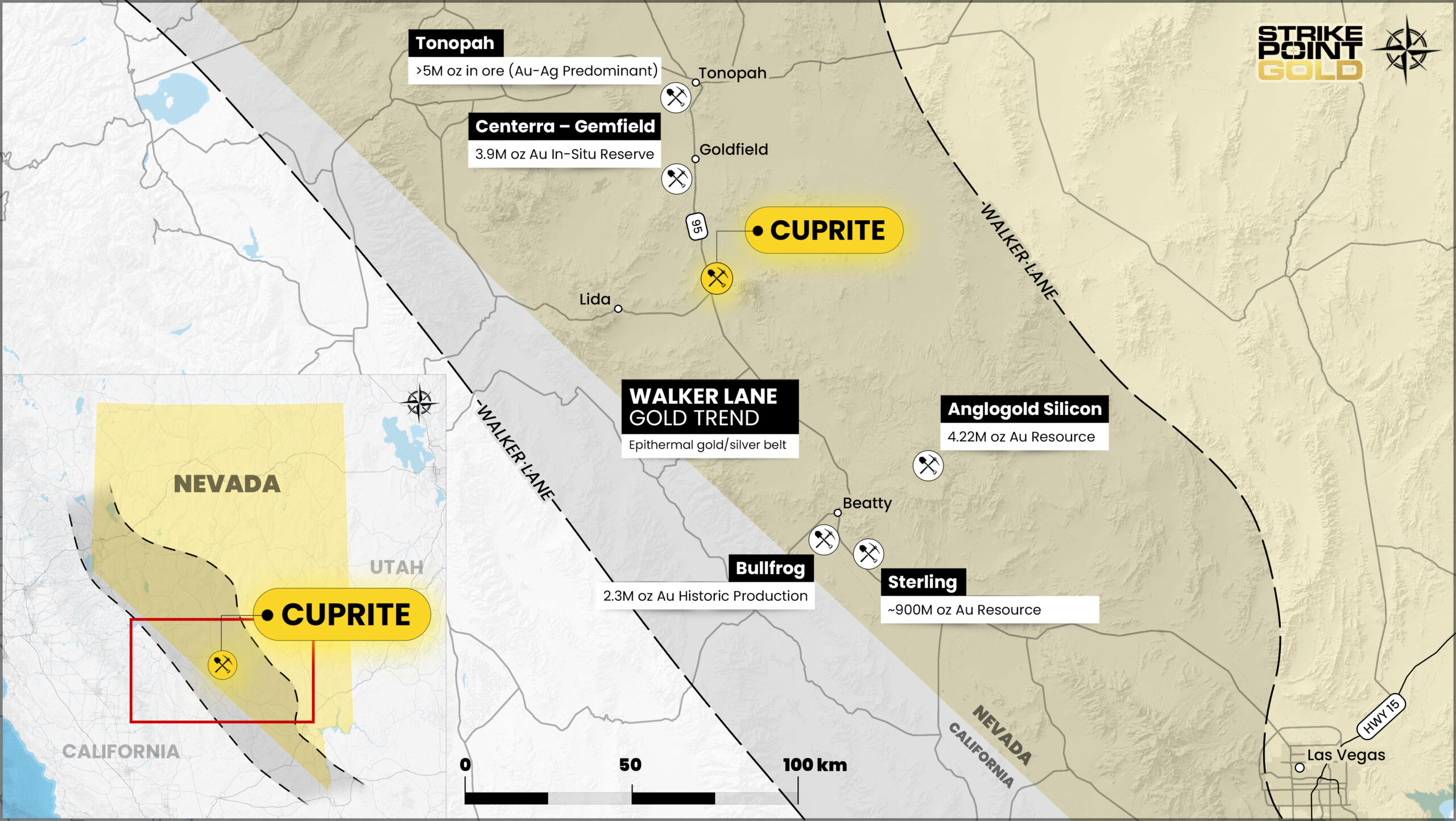
The 100%-owned Cuprite property was acquired by StrikePoint through the purchase of claims from Orogen Royalties Inc., and subsequent staking. The property is located approximately 18km south of Goldfield, Nevada. The property overlaps a large area of advanced-argillic alteration of the steam-heated type with similarities to the alteration exposed above the Silicon gold-silver deposit, which is part of the multimillion Au oz Arthur Gold Project located near Beatty, Nevada, approximately 75km south of Cuprite. Orogen retains a 3% net smelter return (“NSR”) royalty, which StrikePoint has the right to purchase from Orogen 0.5% of the NSR royalty for $2.5 million. Orogen will also hold a one-kilometer area of interest around the Cuprite property, with additional claims staked within this area of interest will be subject to the 3% NSR. Orogen will also retain a 1.5% NSR royalty on any subsequently acquired internal claims held by other
owners.
StrikePoint considers the Cuprite property to be an early-stage exploration project and a non-core asset. While the Company has no current exploration programs for Cuprite, StrikePoint will be maintaining certain claims in the area in good standing and will consider future exploration programs at Cuprite should an opportunity to increase shareholder value arise.
The information that follows includes exerts from the Company’s most recent NI 43-101 Technical Report on Curprite entitled “Updated Technical Report on the Cuprite Gold – Silver Project, NYE and Esmeralda Counties, Nevada, USA” dated June 24, 2026 (with an effective date of May 14, 2026) (the “Cuprite Technical Report”). The report was prepared by Bryan A. Kellie, C.P.G. and Steven I. Weiss, C.P.G., PhD. (together, the “Authors”, who are independent of StrikePoint Gold).
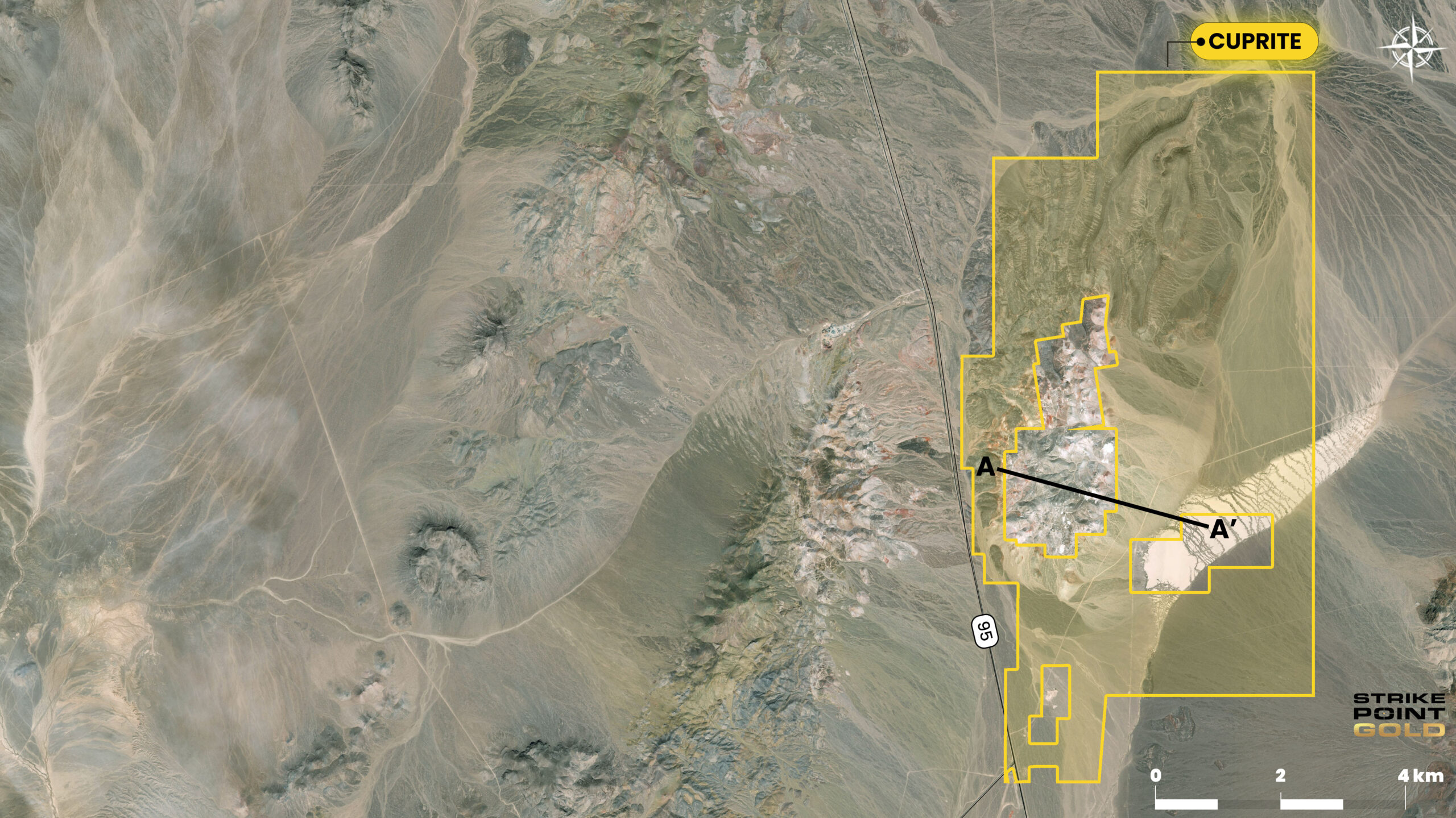
The Cuprite property is centered at approximately 37°33′00″N and 117°09′30.″W in southwestern Nevada, approximately 20km south of the town of Goldfield in adjacent portions of Esmeralda and Nye Counties. The property consists of 376 unpatented federal lode mining claims that in aggregate cover approximately 2,892 hectares. The current annual fees for the Cuprite unpatented mining claims are estimated at $82,200 and there are no other annual holding costs for the Cuprite property.
The Cuprite property is in the eastern portion of the Cuprite mining district where minor amounts of sulfur, silica, mercury, and clay are believed to have been produced in 1914-1918 and again in 1960. Cinnabar occurrences were prospected in the 1930s. Numerous dozer cuts and about a half-dozen small dozer excavations in white, clay-altered and opalized tuffs within a kilometer of the property boundaries likely date from 1950s to 1970s clay, mercury, and silica exploration.
The Cuprite district is situated in the Goldfield segment of the Walker Lane belt, a broad, northwest southeast oriented zone of strike-slip and trans-tensional deformation between the Sierra Nevada and Basin and Range geologic provinces of Nevada and California. Southeast of Goldfield, the Walker Lane belt transects the 15Ma to 7Ma Southwestern Nevada Volcanic Field (“SWNVF”). The project area is located near the northwestern margin of the SWNVF, only a few kilometers from exposures of the late Miocene Stonewall Mountain volcanic center. In the western and northern portions of the property, bedrock exposures principally consist of rocks
assigned to the Miocene Siebert Formation and underlying, crystal-rich ash-flow tuff of Oligocene age. In the western and central areas of the property, the Siebert is overlain by the peralkaline rhyolite ash-flow sheets of the ca. 7.5Ma Spearhead and Civet Cat Canyon members of the Stonewall Flat Tuff. The southern and eastern portions of the property are covered by Quaternary-age, little-consolidated alluvial fan deposits of sand, silt, gravel and conglomerate.
The Cuprite property surrounds and overlaps an approximately 5km north-south by 2km east-west area of advanced-argillic and argillic alteration has affected rocks as young as the Stonewall Flat Tuff. The principal silica minerals are opal and chalcedony, often in crumbly to powdery, porous leached rock characteristic of a steam-heated setting above the paleo-groundwater table. Small amounts of native sulfur and cinnabar can be found locally in the acid-leached rocks.
StrikePoint conducted a 3,069m reverse-circulation rotary drilling program consisting of five angled holes in the spring of 2024. All drill holes reached pre-Tertiary basement rocks of the Cambrian Harkless Formation and four of the five holes intercepted anomalous gold and silver mineralization. Mineralized intervals are summarized in Table 1-1.
Table 1-1 Mineralized Intercepts in 2024 Drilling by StrikePoint
(converted to meters from StrikePoint news release of June 4th, 2024)
| Hole ID | From (m) | To (m) | Length (m) | Au g/t | Ag g/t |
|---|---|---|---|---|---|
| SKP24-001 | 362.71 | 374.90 | 12.19 | 0.46 | 10.10 |
| including | 364.24 | 370.33 | 6.10 | 0.74 | 14.75 |
| SKP24-002 | No Significant Intercepts | ||||
| SKP24-003 | 271.27 | 275.84 | 4.57 | 0.17 | 1.97 |
| and | 475.49 | 480.06 | 4.57 | 0.14 | 0.93 |
| SKP24-004 | 397.76 | 403.86 | 6.10 | 0.21 | 4.15 |
| and | 419.10 | 425.20 | 6.10 | 0.17 | 2.23 |
| SKP24-005 | 364.24 | 365.76 | 1.52 | 0.11 | 1.10 |
| and | 425.20 | 426.72 | 1.52 | 0.16 | 1.10 |
| and | 475.49 | 484.63 | 9.14 | 0.19 | 5.95 |
| incl | 478.54 | 483.11 | 4.57 | 0.29 | 9.13 |
| and | 531.88 | 536.45 | 4.57 | 0.20 | 2.00 |
| and | 553.21 | 554.74 | 1.52 | 0.21 | 1.90 |
| and | 560.83 | 569.98 | 9.14 | 0.17 | 2.00 |
(The relation of the drilled interval lengths to the true thickness of mineralized rocks is not known.)
Gold and silver mineralization are not known to be present at current levels of exposure. However, one or more major episodes of boiling of near-neutral pH fluids at depth are reasonably expected to have occurred given the large aerial extent and intensity of the steam-heated advanced argillic zone at Cuprite, which is interpreted to reflect a voluminous, district-scale epithermal system. Boiling of near-neutral pH hydrothermal fluids is an important mechanism for the formation of low-sulfidation epithermal preciousmetal deposits within faults and fracture zones, and/or permeable lithologies, beneath the paleowater table at the time of hydrothermal activity. In the last decade or so, two significant and potentially economic gold-silver deposits have been discovered by drilling beneath areas of steam-heated advanced-argillic alteration in southwestern Nevada. These include the Silicon gold-silver deposit approximately 75km southeast of Cuprite, which was discovered by AngloGold Ashanti in 2019 by drilling in a large zone of barren advanced-argillic alteration (2022 Inferred resources at the Silicon project of 120.4 million tonnes averaging 0.87g Au/t and 3.66g Ag/t, for 3.37 million contained ounces of gold and 14.17 million contained ounces of silver) (Bartos et al., 2022). The authors have been unable to verify the information of Bartos et al. (2022) and the information is not necessarily indicative of the mineralization on the property that is the subject of this technical report. At the Eastside gold-silver deposit, approximately 80km northwest of Cuprite, drilling has demonstrated the presence of gold and silver mineralization beneath an extensive area of steam-heated advanced-argillic alteration centered on a cluster of rhyolite flow-domes (2021 Inferred resources of 61.73 million tonnes averaging 0.55g Au/t and 4.4g Ag/t for 1.09 million contained ounces of gold and 8.7 million ounces of contained silver) (Ristorcelli, 2021). The Authors have been unable to verify the information of Ristorcelli (2021), and the information is not necessarily indicative of the mineralization on the property that is the subject of the Cuprite Technical Report.
At the Cuprite property, the vertical depth from the present-day surface to the base of the steam-heated zone, and the levels beneath the paleowater table at the time of boiling that could be prospective for gold-silver mineralization were tested in a reconnaissance fashion by StrikePoint’s drilling in 2024. Four of the five holes drilled by StrikePoint encountered elevated gold and silver concentrations at down-hole depths ranging from 270m to as much as 570m, demonstrating the paleohydrothermal system carried precious metals, at least locally.
For additional information on the Authors recommended program at Cuprite, refer to the Cuprite Technical Report. The Company does not currently have any plans to execute further exploration programs at Cuprite, which is subject to change, pending available financing and management determination that additional programs will create shareholder value.